Scott Carey and Louise Carey
The Shrinking ManScott Carey and Louise Carey’s marriage is strained not by a single rupture but by the practical and emotional consequences of Scott’s shrinking. As his body falls below the scale at which he can care for Beth or move freely through the household, Louise must make arrangements without him. Their recurring parting becomes a compact image of the larger separation: Louise leaves for work, the cellar door closes and locks, and Scott is left to confront a world in which he can no longer occupy his former place as husband and father.
Household Responsibilities and Separation
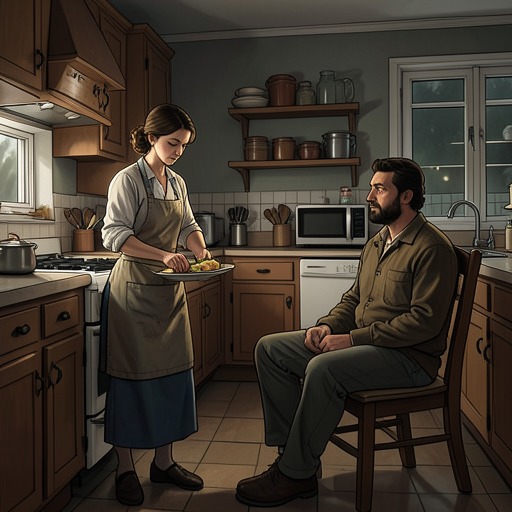
Louise’s new job follows the end of summer, when the teenage girl who had worked at the lake grocery store returns to school. Louise had applied for the opening a month earlier, but she had vaguely assumed Scott would take care of Beth once she began working. By then Scott barely reaches Beth’s chest, and Louise recognizes that he cannot look after her. Scott also refuses to try. Louise therefore arranges for a neighborhood girl who has left high school to care for Beth while she works, despite the cost and her sense that the household has few alternatives.
The arrangement exposes how shrinking has changed the couple’s division of responsibility. Louise has to plan for both her employment and Beth’s care, while Scott does not participate in the solution. She tells him that he will have to stay in the cellar during the day unless he wants the neighborhood girl to discover who he is: he cannot pass for a child. Scott only shrugs his small shoulders and leaves without answering. The gesture leaves Louise to manage the consequences, while his silence registers a withdrawal from the family life that once depended on his adult role.
The Locked-Door Routine
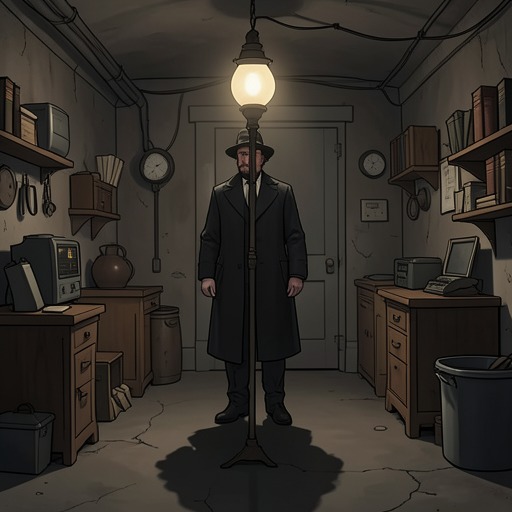
Their separation becomes a repeated domestic ritual. Louise comes downstairs, says goodbye, and kisses Scott on the top of the head. He draws away from the kiss. As she climbs the steps, he rhythmically slaps folded newspapers against his leg. In his mind, the day’s pattern is already fixed: sandwiches and coffee in the cellar, a goodbye peck, Louise leaving, then the door lowering and the lock snapping shut.
The lock turns an arrangement made for privacy into an experience of confinement. Scott hears it and is seized by terror; he sees Louise’s legs moving away and presses his lips together to suppress a cry. He understands himself as a secret that decent people must keep hidden, and the cellar as the place where that secret is secured. Once the immediate tension subsides, he returns to passive routine, climbing onto a chair to light a cigarette, drinking coffee, and leafing through the previous evening’s paper. The ordinary objects and actions do not soften the separation; they show how thoroughly the locked cellar has become the structure of his days.
Even a brief interruption can momentarily restore the marriage’s former emotional force. When the music stops, Scott listens in the dark to the muffled voice of the woman who had been his wife. His heart seems to stop, and for an instant he feels part of the old world again. The moment is brief, but it makes audible what the daily routine obscures: Louise remains emotionally significant to him even as their shared life becomes harder to sustain.
Clarice and the Need for Companionship
Scott’s connection with Clarice sharpens the difference between his marriage and the companionship he can still reach. He tells her that he has been alone since passing a certain height, and that this isolation explains the strength of his feelings toward her. When she responds with distress to his description of their shared condition as pitiful, he apologizes and admits how bitter he has become. Their closeness is conveyed physically as well as verbally: Scott strokes her hand, they press against one another, and he feels her heartbeat against his chest.
Clarice understands the difference in their experiences. She has lived with her condition all her life and has had time to adjust; Scott, by contrast, has watched Louise and Beth grow larger in relation to him every day. He recognizes that even Clarice will eventually become a giant to him. Their intimacy therefore offers respite, not a way out of the shrinking that has divided him from his family. He asks Clarice how she found him and, when she worries that Louise may be frightened, urgently asks her not to make him go.
The Appeal to Louise
Scott eventually makes his case directly to Louise. He insists that his relationship with Clarice is not merely an animal impulse or something disgusting. He and Louise, he says, are no longer the same: they are apart, and she will be able to find companionship when his own shrinking has run its course. He expects her to remarry after his life is over. The future he describes for himself is continued shrinking, dissolution, and increasing loneliness; even Clarice will one day be beyond his reach.
His request is specific and limited. He asks Louise for one night with Clarice, presenting it as a chance for peace, affection, and love rather than as a denial of what he and Louise once shared. He also points out that Clarice has a trailer furnished with objects he can use. The detail makes the contrast concrete: the trailer can accommodate his body, while the ordinary household and marriage have become difficult for him to inhabit. Louise stands shaking with silent sobs before agreeing that stopping him would be pointless and cruel. She says she will return in the morning and runs to the car.
Her permission does not erase the hurt or restore their earlier closeness. Scott watches the taillights disappear, feels ill and miserable, and thinks he should not have gone through with it. Yet the trailer’s light and its small steps draw him back toward Clarice. For him, entering it is like leaving the sorrows of the old world behind. The episode makes the marriage’s altered terms explicit: Louise can acknowledge his need, but she cannot offer the companionship he seeks at his present scale.
The Last Distance
Later, during the move, Scott sees Louise again while she is standing in the house. The sight makes the change in their relation undeniable to him. He thinks of trying to tell her that he is alive, but the thought evaporates; he sees himself as an insect to her and concludes that attracting her attention would change nothing. He would still be gone that night, and he might only reopen a wound that had nearly closed.
Scott remains silent, looking up at the woman who had been his wife as Marty comes back down the steps. This is not a reconciliation or a new exchange between them, but Scott’s private recognition of a distance he no longer believes he can cross. Earlier, Louise’s muffled voice could briefly return him to the old world; now, seeing her confirms that he has become unreachable within it. His choice not to reveal himself completes the movement from enforced separation to a separation he accepts as the least harmful course available to him.